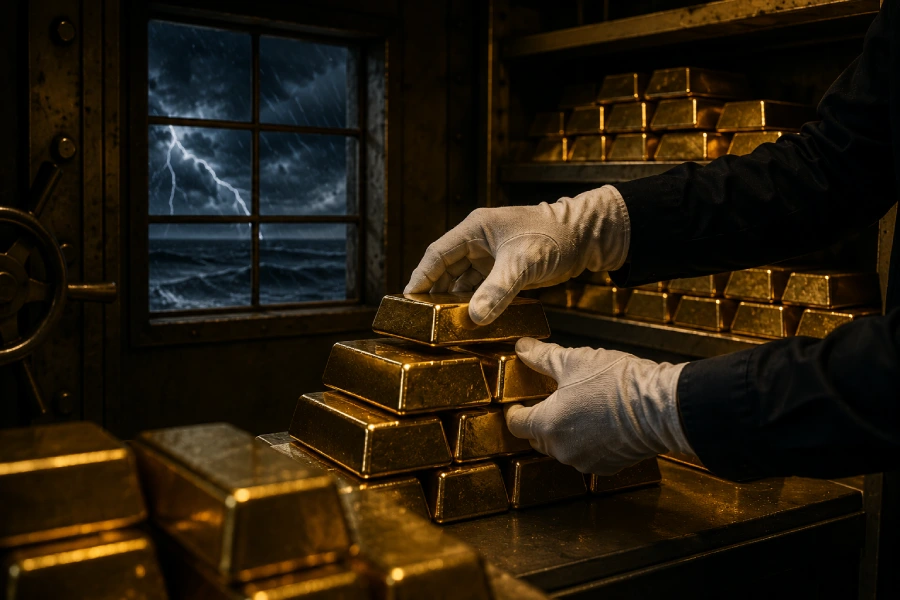
Gold has fallen to around $4,020 per ounce this Monday July 13 — roughly 28% below its January record of $5,597, and the deepest discount of the entire year. The cause is the collapse of the Middle East ceasefire: Iran has declared the Strait of Hormuz closed, the US has struck 140 targets, oil has surged 7%, and the resulting inflation fears have driven Fed rate-hike bets to nearly 70%. For anyone holding gold, this is a genuinely difficult day, and it deserves honesty rather than false comfort. But it also deserves perspective — because while the price falls, the world’s most patient buyer is accumulating at the fastest pace in years.
Let us be honest about the storm first. Gold is down about 7.3% over the past month. The war has returned, and paradoxically it is pushing gold down rather than up, because the closure of Hormuz drives oil higher, which drives inflation higher, which forces the Federal Reserve to stay hawkish — and high interest rates are gold’s greatest enemy. This is a real, powerful headwind, and it may persist as long as the conflict does. Fed Chair Warsh testifies before Congress on Tuesday, and the June CPI report arrives this week; if inflation runs hot on the oil surge, more pressure could follow.
Now the roots. In June — while the price was falling — China’s central bank reported its largest monthly increase in gold reserves in more than two and a half years. Read that again. The world’s most strategically patient buyer, at the moment of maximum price weakness, accelerated its buying to the fastest pace since late 2023. This is not a coincidence. Central banks buy gold not for next month’s price but for its role as a lasting store of value that no government can print, no war can destroy, and no interest rate decision can invalidate. When the price falls, they buy more. Their conviction is the deepest root beneath the gold market.
This is the pattern that has defined gold for centuries. The price swings violently on short-term forces — wars, oil shocks, Fed decisions, currency moves. But underneath, the structural buyers accumulate steadily through every storm, building an ever-higher floor. The visible tree bends dramatically in the wind; the roots grow deeper in the dark.
Consider what has not changed. Mine supply still grows at just 1% to 2% per year. Global debt continues to deteriorate. The multi-polar shift away from dollar dependence accelerates. Central banks worldwide keep accumulating, with China now leading at its fastest pace in years. And despite the worst month in a while, gold remains up 19.5% over the past year — a reminder that even after this fall, long-term holders are substantially ahead.
The patient gardener does not judge the tree by its hardest storm, nor uproot it because the wind is howling. Gold at $4,020 is painful today. But the deepest discount of the year is also, historically, the moment when the most patient buyers accumulate — and right now, China’s central bank is doing exactly that. The roots have never been deeper.