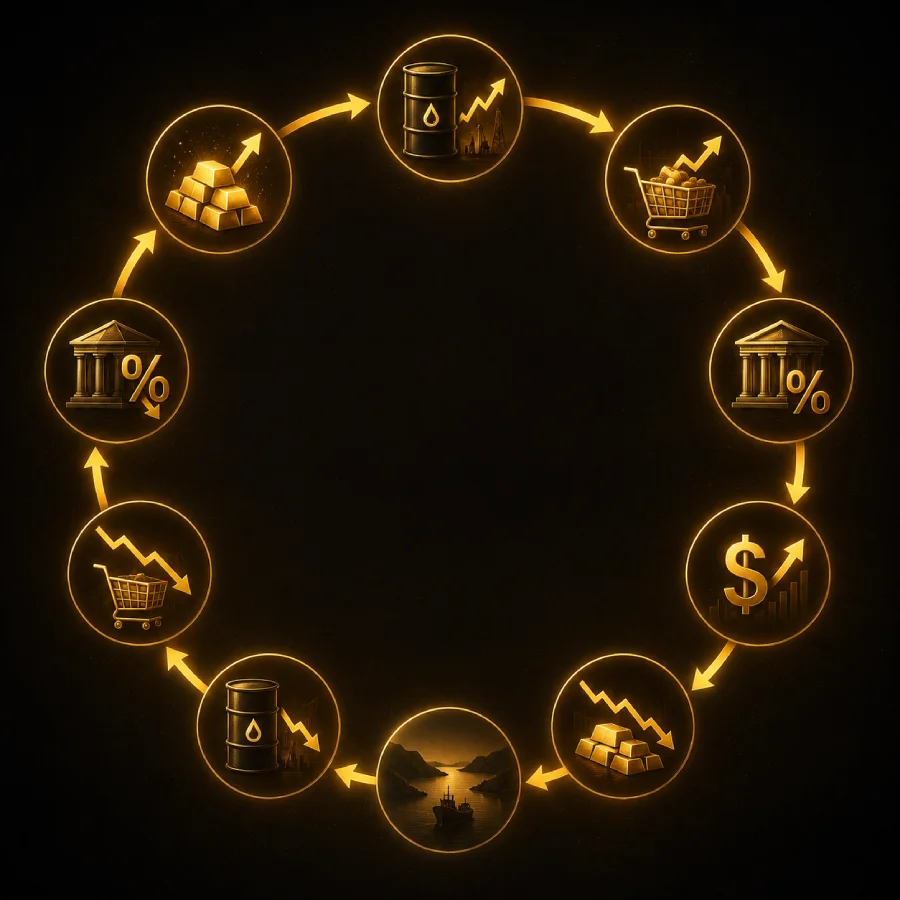
Israel struck an Iranian petrochemical facility this morning despite direct American requests to stop. Oil surged 4.47%. The conflict has escalated on a day when gold was already struggling below $4,400 after Friday’s strong jobs report. Gold is trading near $4,340 — down roughly 22% from January’s all-time high of $5,595. By every normal rule of financial history, a major escalation in a Middle East war should send gold sharply higher.
It has not. And understanding why is the entire story of gold in 2026.
The answer is the same now as it was in March, April, and May. The Iran war is not just a war. It is an oil embargo. When Israel strikes Iranian energy infrastructure and Iran closes or threatens the Strait of Hormuz, oil prices spike. Brent is now at $97.15 after today’s attack. When oil is at $97, inflation runs hot. When inflation runs hot, the Federal Reserve keeps interest rates high or raises them further. When interest rates are high or rising, the US dollar strengthens. When the dollar strengthens, gold — priced in dollars globally — faces mechanical downward pressure. The war that should send gold to $6,000 is instead working through an inflation channel that suppresses it.
The Mahshahr strike this morning extended that mechanism for another cycle. Oil up, inflation expectations up, rate hike probability up, gold down. The market priced this within minutes of the news breaking.
But here is what the paradox’s resolution looks like, and why it still points to gold going substantially higher from current levels. The mechanism only operates as long as Hormuz is closed and oil is above $90. The moment Hormuz reopens — which both the US and Iran have agreed in principle to do, even if Israel’s actions today have delayed the timeline — oil falls to $80 or below within weeks. When oil falls, inflation falls. When inflation falls, the Fed’s hawkish posture evaporates. When the Fed softens, gold rises. The entire suppressive mechanism runs in reverse.
The war has pushed gold from $5,595 to $4,340. Goldman Sachs still targets $5,400 by year-end. The tree is still growing underground. The paradox is temporary. The roots are permanent.